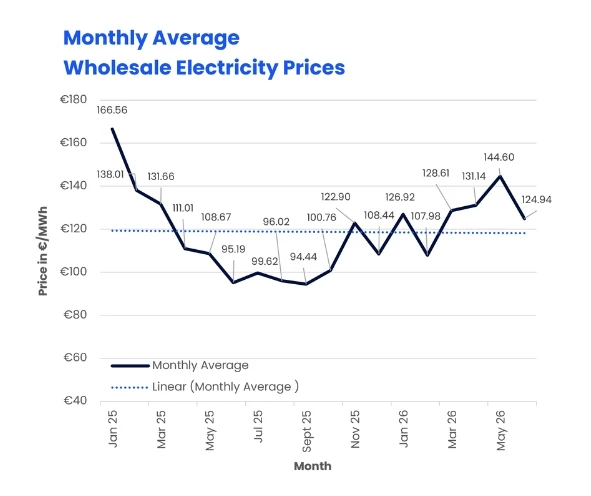
Wholesale Electricity Prices in Ireland
- Irish wholesale electricity prices are currently trading at €124.94 per MWh, down 13.6% compared to May 2026. Prices remain above June 2025 levels but continue to track well below the peaks seen in previous energy market disruptions.
- Despite ongoing tensions in the Middle East, the impact on Irish business electricity prices has been relatively limited. Businesses entering new electricity contracts can generally expect pricing to be around 5% higher than last year.
- Wind generation supplied an average of 46% of Ireland's electricity demand so far in 2026, reducing reliance on natural gas and helping to shield wholesale electricity prices from volatility in global energy markets.
- In addition, approximately 50% of business electricity bills consist of regulated network and market charges (grid fees). As these charges have remained unchanged, movements in wholesale electricity prices have had a reduced impact on final bills.
Wholesale Natural Gas Prices
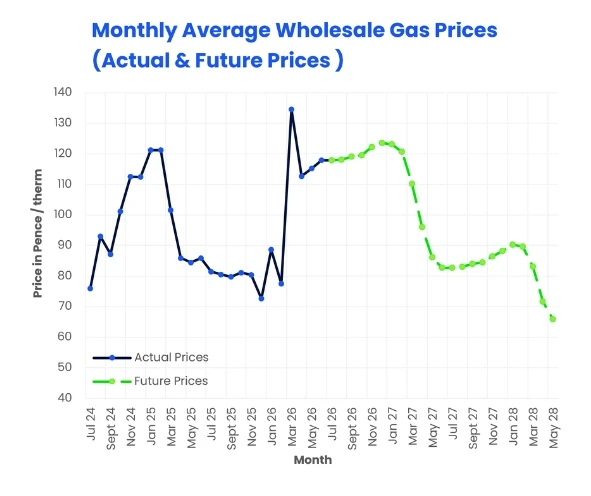
- UK day-ahead natural gas prices are currently at 117.93 pence per therm, while the EU benchmark (TTF) is trading at €48.5 per MWh, which is equivalent to 122.94 pence per therm.
- Gas prices have remained broadly stable month-on-month, increasing by 2.2% compared to May 2026, but still 37.4% higher than June 2025, placing upward pressure on business energy costs.
- The 12-month forward gas price is 24% higher compared to June 2025, which translates into a 10%–12% increase in new business gas contracts, once unchanged network charges are included.
- EU gas storage levels currently stand at 41%, approximately 14% below the 5-year average for this time of year. Lower storage levels and LNG supply uncertainty continue to support a firmer price environment heading into next winter.
Global Oil Commodity Prices
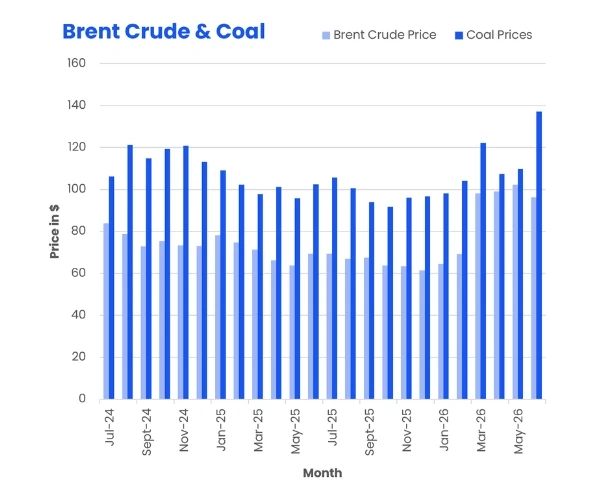
- Brent crude oil is currently trading at $96.58 per barrel, down 5.8% compared to May 2026, but still 38.8% higher year-on-year, reflecting continued elevated global energy costs.
- Oil markets remain volatile, with prices trading in a broad range of $90–$110 per barrel as supply and demand expectations shift in response to daily newsflow and geopolitical developments.
- Despite recent easing from earlier highs, global oil inventories remain below historical averages. This means markets will remain sensitive to any disruption in supply in the coming months, until stockpiles are rebuilt.
- Coal prices have increased to $134.25 per metric tonne, up 24.9% on last month, and 33.7% higher year-on-year. This is driven by production suspensions at 25 mines in Shanxi, China for safety inspections.
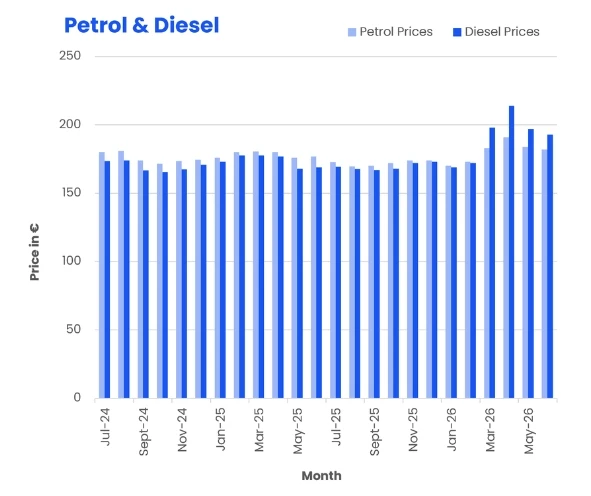
Petrol & Diesel Pump Prices in Ireland
- Average petrol prices in Ireland are currently €1.82 per litre. Petrol prices are 1.1% lower than last month and 2.8% higher year-on-year.
- Average diesel prices are currently €1.93 per litre. Diesel prices are 2% lower than last month and 14.2% higher year-on-year.
- To ease immediate pressure on fuel pump prices, the Irish government cut excise duty until July 2026 (reducing pump prices by approximately 30 cents for petrol and 25 cents for diesel) and delayed the planned carbon tax increase to October 2026.
- These measures have helped keep fuel pump prices below €2 per litre, but global oil markets remain volatile. Any escalation in tensions or further oil supply disruptions could quickly reverse these reductions.
Summary
- The impact of the war on electricity prices has been limited due to (i) wind production accounting for 46% of generation and (ii) grid fees, which account for 50% of bills, are unchanged. New business electricity contracts are 5% higher than last year.
- The 12-month forward gas price is 24% higher than June 2025, translating into a 10–12% increase in new business gas contracts. EU gas storage levels sit 14% below the 5-year average, which may renew price pressure ahead of winter.
- Oil prices continue to fluctuate between $90–$100 per barrel depending on daily newsflow. While prices have returned to early-March levels, global inventories remain below average, keeping markets sensitive to supply disruption.
- If your current contract expires in the near term, avoid rushed decisions and consider all contract options, including wholesale electricity trackers, short-term fixed contracts, or longer contracts that let you average in at a lower price.