
30-Second Overview
Over the past decade, Ireland's electricity system has undergone one of its biggest transformations. Coal has almost disappeared from the national grid, wind generation has more than doubled, solar farms have emerged as a significant new source of electricity, and renewable generation now supplies almost half of Ireland's electricity.
Using data compiled from the Sustainable Energy Authority of Ireland (SEAI), this report analyses Ireland's electricity generation between 2016 and 2026, showing how the country's fuel mix has evolved and what these changes mean for Irish businesses.
⚡ Not sure if you're paying too much for your business electricity?
Upload a recent electricity bill and our energy experts will prepare a full side-by-side supplier comparison and savings report, showing your current rates alongside the most competitive offers from every Irish supplier. 👇
Why Ireland's Electricity Fuel Mix Matters for Irish Businesses
Every unit of electricity consumed in Ireland is generated from a combination of fuel sources, including natural gas, wind, solar, hydro, biomass and waste-to-energy. The proportion generated by each source changes constantly depending on electricity demand, weather conditions and the availability of generation capacity.
Over the last decade, Ireland has made significant progress towards a cleaner and more diverse electricity system. Investment in renewable energy has increased substantially, while coal and peat generation have been phased out.
Although these changes do not directly determine the price businesses pay for electricity, they provide valuable insight into how Ireland's electricity market is evolving. Understanding the country's generation mix helps explain why wholesale electricity prices behave as they do and why choosing the right procurement strategy remains so important.
Ireland's Electricity Generation – Fuel Source Changes 2016-2026
| Fuel Source (% of Electricity Generated in the Year) |
2016 | 2026 (to date) | Change % |
|---|---|---|---|
| Natural Gas | 52.33% | 47.94% | -8% |
| Wind | 19.78% | 39.22% | +98% |
| Solar Farms | 0.00% | 7.01% | +701% |
| Hydro | 1.77% | 2.12% | +20% |
| Wastes | 0.46% | 1.32% | +186% |
| Peat & BM | 8.74% | 1.70% | -81% |
| Renewable Fuels | 0.64% | 0.50% | -21% |
| Oil | 0.17% | 0.15% | -11% |
| Coal | 16.10% | 0.00% | -100% |
How Ireland's Electricity Generation Has Changed From 2016 to 2026
Natural Gas Remains Ireland's Largest Source of Electricity
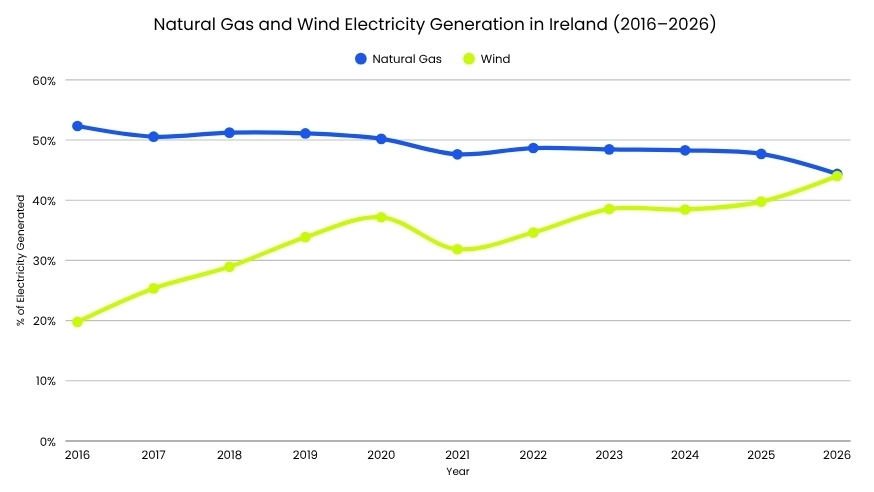
Natural gas has remained Ireland's single largest source of electricity generation throughout the last decade. Although its share has fallen from 52.3% in 2016 to 44.4% in 2026 (to date), gas-fired power stations continue to play a vital role in maintaining a reliable electricity supply.
Unlike renewable generation, gas-fired stations can quickly respond to sudden changes in electricity demand or periods when wind and solar output are lower. For this reason, natural gas remains essential for maintaining the stability and security of Ireland's electricity grid.
Wind Has Almost Caught Up with Natural Gas
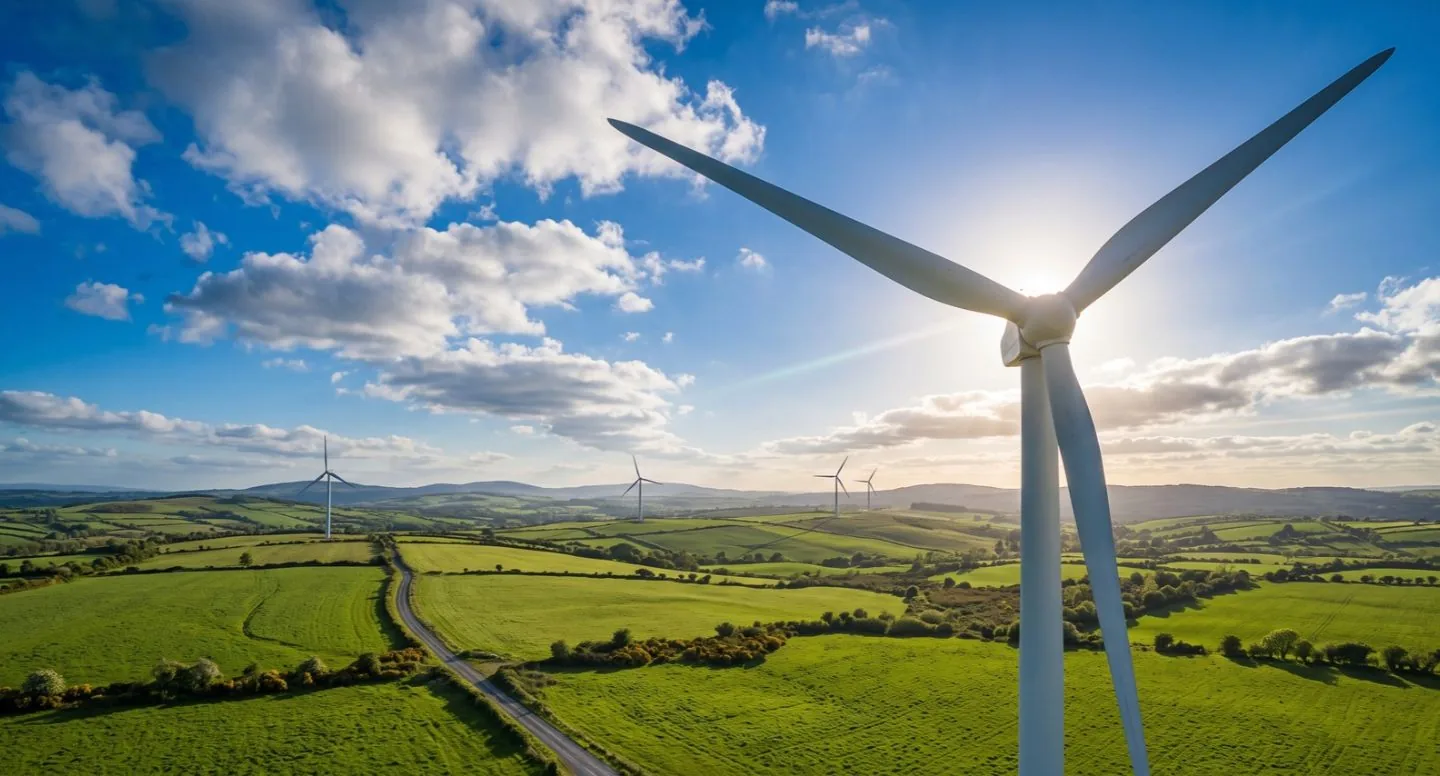
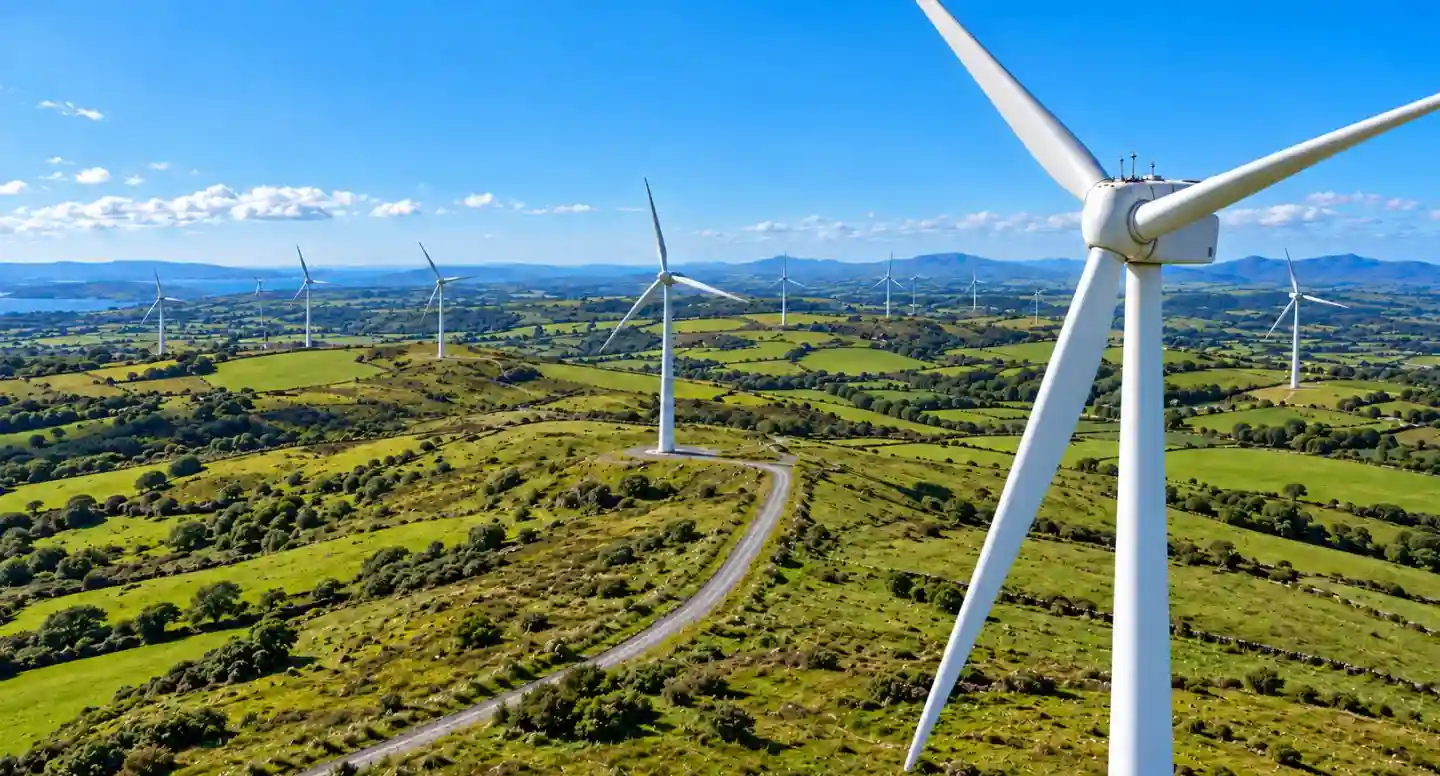
Wind energy has experienced the largest growth of any electricity source over the past decade. Its contribution has increased from just 19.8% of Ireland's electricity generation in 2016 to 44.0% in 2026 (to date), bringing wind within a fraction of overtaking natural gas as Ireland's largest source of electricity.
This represents one of the biggest changes in Ireland's energy system in recent decades. As more wind farms have been developed, Ireland has become less dependent on imported fossil fuels while significantly reducing the carbon intensity of electricity generation.
However, wind remains weather dependent. When wind speeds fall or electricity demand rises rapidly, gas-fired generation continues to provide the flexibility needed to keep the electricity system balanced.
Coal and Peat Have Been Phased Out
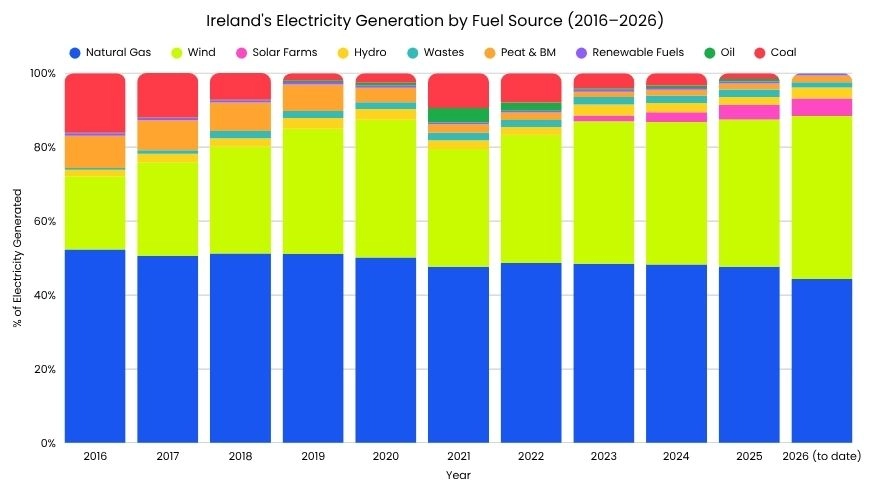
Coal and peat have been phased out over the past decade as Ireland continues moving towards lower-carbon electricity generation. This transition reflects changes in Ireland’s environmental policies, the retirement of older generating stations and the commitment to reducing greenhouse gas emissions nationwide.
Solar is Emerging as a Meaningful Contributor
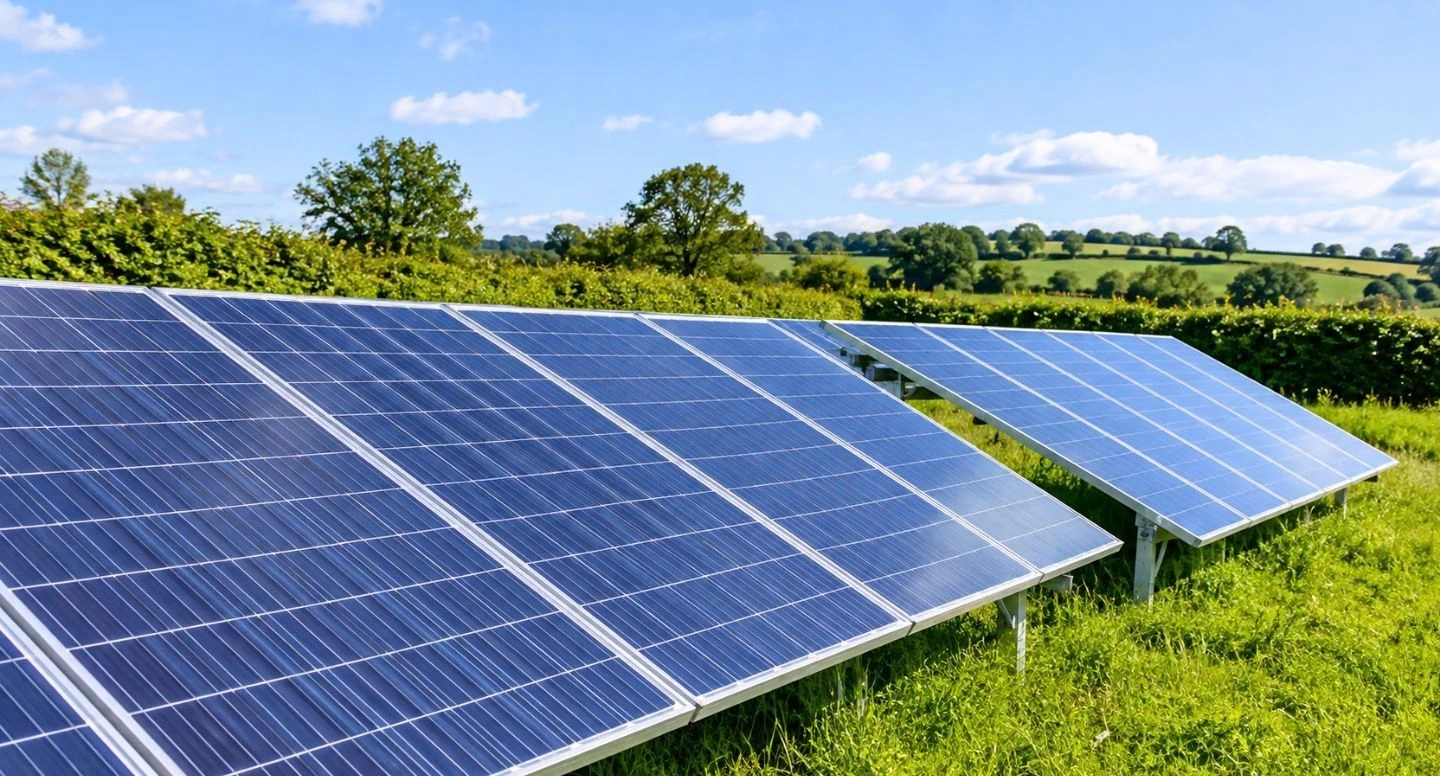
Although virtually non-existent before 2023, solar farms and microgeneration arrays are becoming an increasingly important part of Ireland's electricity system.
As additional solar projects connect to the grid, solar generation continues to grow and complements wind by producing the most electricity during spring and summer when daylight hours are longest.
While solar still contributes a relatively small share of annual generation compared with wind, its rapid growth is expected to continue over the coming years.
Renewable Generation Continues to Increase
Wind, solar, hydro and other renewable technologies now account for a significantly larger share of Ireland's electricity generation than they did ten years ago. The result is a cleaner and more diverse electricity system that is less reliant on fossil fuels than ever before.
However, Ireland still requires a balanced mix of generation technologies to ensure electricity remains available whenever homes and businesses need it.
If Wind Has Doubled, Why Haven't Electricity Prices Halved?
This is one of the questions we are asked most often by Irish businesses. While wind generation has increased dramatically, renewable electricity is only one factor that influences commercial electricity prices.
Natural gas continues to play a major role in setting wholesale electricity prices because gas-fired power stations are frequently the final generators required to meet electricity demand.
In addition, electricity bills include several other costs and grid fees, which are largely unaffected by wholesale energy markets, including:
- Network charges
- Capacity charges
- Carbon costs
- Supplier operating costs
- Government and regulatory charges
For most Irish businesses, around half of an electricity bill relates to network and regulatory charges rather than the cost of generating electricity itself. Furthermore, as more renewables are added to the electricity grid, capital investment is needed to accommodate the increase in renewable assets, which pushes up network charges and government levies.
Ireland's Annual Electricity Fuel Mix (2016-2026)
| Year | Natural Gas | Wind | Solar Farms | Hydro | Wastes | Peat & BM | Renewable Fuels | Oil | Coal |
|---|---|---|---|---|---|---|---|---|---|
| 2026 (to date) | 47.94% | 39.22% | 7.01% | 2.12% | 1.32% | 1.70% | 0.50% | 0.15% | 0.00% |
| 2025 | 47.69% | 39.77% | 3.98% | 2.10% | 2.02% | 1.66% | 0.52% | 0.68% | 1.55% |
| 2024 | 48.29% | 38.46% | 2.69% | 2.47% | 2.02% | 1.56% | 0.51% | 0.68% | 3.27% |
| 2023 | 48.45% | 38.53% | 1.47% | 3.08% | 2.01% | 1.40% | 0.56% | 0.38% | 4.08% |
| 2022 | 48.67% | 34.63% | 0.04% | 2.09% | 1.86% | 2.04% | 0.51% | 2.21% | 7.91% |
| 2021 | 47.63% | 31.86% | 0.00% | 2.37% | 2.04% | 2.28% | 0.49% | 3.90% | 9.37% |
| 2020 | 50.19% | 37.17% | 0.00% | 2.92% | 1.84% | 3.90% | 0.61% | 0.75% | 2.56% |
| 2019 | 51.10% | 33.86% | 0.00% | 2.93% | 1.88% | 7.12% | 0.72% | 0.45% | 1.93% |
| 2018 | 51.23% | 28.93% | 0.00% | 2.26% | 1.93% | 7.67% | 0.62% | 0.18% | 7.18% |
| 2017 | 50.56% | 25.35% | 0.00% | 2.31% | 0.94% | 8.12% | 0.61% | 0.08% | 12.05% |
| 2016 | 52.33% | 19.78% | 0.00% | 1.77% | 0.46% | 8.74% | 0.64% | 0.17% | 16.10% |
What This Means for Irish Businesses
Ireland's electricity system has changed dramatically over the past decade. Coal has almost disappeared, renewable generation continues to expand and wind generation is now almost equal to natural gas as Ireland's largest source of electricity.
These developments are helping reduce Ireland's long-term reliance on imported fossil fuels and supporting the country's transition towards a lower-carbon electricity system. However, businesses should not assume that increasing renewable generation automatically results in lower electricity prices.
Wholesale electricity prices continue to be heavily influenced by natural gas markets, international events, supplier procurement strategies and regulated network charges.
For this reason, understanding both long-term generation trends and current wholesale market conditions is essential when deciding the right time to renew an electricity contract.
Compare Commercial Electricity Prices From Every Irish Supplier
Whether your business is approaching contract renewal or you are exploring 100% renewable electricity options, Utilityfair’s platform quickly compares commercial electricity prices from every Irish supplier, saving you time and money.
Our energy experts will:
- Compare every available supplier.
- Explain the advantages and disadvantages of fixed-price and wholesale tracker contracts.
- Review your current tariff and contract end date.
- Prepare a side-by-side supplier comparison and explain the available options.
- Manage the entire switching process with no disruption.
👉 Get Started Today!
Fill out our enquiry form, click the link below for a free, no-obligation comparison, or call 01 547 0999 to speak with one of our energy experts today.


Frequently Asked Questions (FAQs)
Ireland generates electricity from natural gas, wind, solar, hydro, biomass, waste-to-energy and electricity imported through interconnectors. The proportion generated by each source changes throughout the year depending on weather conditions and electricity demand.
Wind is Ireland's largest renewable electricity source and now generates approximately 40% of the country's electricity annually, although monthly output varies with weather conditions.
Natural gas provides flexible electricity generation that can quickly respond when renewable generation falls or electricity demand increases. It remains essential for maintaining the reliability and stability of Ireland's electricity system.
Higher renewable generation does not automatically result in lower electricity bills. Wholesale electricity prices are still influenced by natural gas markets. In addition, network charges, carbon costs, supplier purchasing strategies and regulatory charges also make up a significant proportion of business electricity bills.
The electricity fuel mix describes the percentage of electricity generated from each fuel source over a given period, including natural gas, wind, solar, hydro, biomass and other technologies.
Renewable electricity generation has increased significantly over the last decade, driven primarily by the rapid expansion of wind energy and, more recently, large-scale solar farms.
The data used in this report is based on publicly available electricity generation statistics published by the Sustainable Energy Authority of Ireland (SEAI). Utilityfair has compiled, organised and analysed the data to identify long-term trends in Ireland's electricity generation between 2016 and 2026.